

Your AI Ops Agent Is Guessing

Yotam Yemini
April 30, 2026
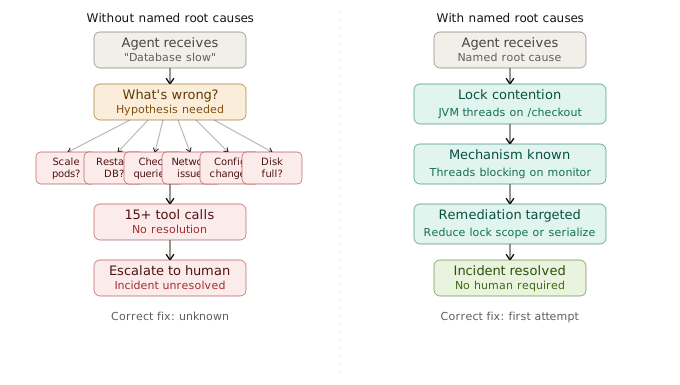
Named root causes are what turn a guessing agent into one you can trust to act without manual review.
TL;DR. AI ops agents fail in production not because they lack telemetry, but because they work from generic diagnoses like "database slow ." A named root cause — with a mechanism, a propagation path, and a remediation — collapses open-ended investigation into a structured answer. Without that grounding, agents hallucinate plausible-sounding explanations from symptoms rather than causes. We've been expanding the causal model to cover more of the failure modes production systems actually exhibit, and there's more to share soon.
Why this matters now
The 2024–2026 wave of LLM-based "SRE agents" has a common architecture: give the agent a set of tools, a system prompt, and enough context to pattern-match, then let it investigate when something breaks. This works in demos. In production, it produces agents that take fifteen tool calls to conclude "the database might be overloaded." We've written before about why LLMs alone aren't enough for root cause analysis. The pattern from our collaboration with Google Gemini, an LLM on top of a causal model, not LLM alone, is an alternative.
Why do generic diagnoses break AI ops, agents?
AI agents are designed to diagnose as a human engineer would, reviewing signals, forming hypotheses, and narrowing in on a cause. It pattern-matches toward the most plausible-sounding explanation. In a degraded system, that's almost always a symptom — the loudest alerting service — not the cause.
Named root causes collapse the search space and guard against unwarranted hallucinations. An agent that receives Lock Contention instead of "database slow " gets the mechanism (competing transactions are blocking each other), the propagation path (which upstream services are affected), and a remediation direction, none of which it could reliably reconstruct on its own. But only if those named causes are grounded in the types of failures your system encounters.
What does a named root cause actually change?
A named root cause collapses the investigation into a diagnosis. Instead of receiving signals and inferring a failure, the agent receives a structured answer: this failure mode, propagating through these services, owned by this team. That affects three things at once.
Accuracy. The agent works from named diagnoses instead of constructing narratives from ambiguous signals. It no longer has to distinguish cause from symptom. The causal graph has already done it.
Cost. A targeted causal query replaces a broad environment scan. In LLM terms, that's the difference between a prompt stuffed with raw telemetry and one carrying a structured answer.
Noise suppression. A richer causal model distinguishes downstream symptoms from genuine root causes rather than firing on both. An agent that can tell a lock-contention cascade from connection-pool exhaustion won't wake three teams for one incident.
Why a causal graph, compounds, and a signature library doesn't
Named root causes in a causal model are not list entries. They are nodes in a graph: connected to the symptoms they produce, the services they propagate through, and the other causes they can be mistaken for. A signature library adds value linearly: each new pattern covers one more situation, and if it doesn't match, you get nothing. A graph adds value non-linearly: when Idle-in-Transaction Accumulation enters, the graph can now distinguish it from connection pool exhaustion, lock contention, and checkpoint I/O pressure, and the agent's reasoning at every neighboring node becomes less ambiguous.
That's the compounding property: the nth named root cause improves diagnoses on the first n−1 by differentiating them.
What "Table Access Failure" tells an Ops agent
A downstream service starts returning errors. An agent without a causal model observes elevated latency and error rates in the data layer, concludes "database overloaded," and recommends scaling, which changes nothing, because the database isn't overloaded. It's inaccessible. Table Access Failure is a distinct failure mode: the database is reachable, but the table itself can't be opened, typically because of permission changes, a dropped or renamed object, or exhausted storage at the tablespace level. The remediation path is specific: verify pg_class for the object, check pg_tablespace for space, and audit recent DDL and permission changes. An agent working from "database slow " will chase connection metrics, miss the permission audit entirely, and escalate to a human with nothing resolved.
What "Lock Contention" tells an agent that "database slow " doesn't
Lock Contention is the failure mode that agents misread as a capacity problem. JVM threads are blocking on synchronized blocks or object monitors; throughput drops; latency climbs. The signals look like an overload. An agent may reach for horizontal scaling or pod restarts, both of which do nothing when the bottleneck is thread contention within the application, not a shortage of instances.
The named root cause carries the mechanism: which threads are contending, which code paths hold the monitor, and the right remediation (reducing lock scope, moving to non-blocking concurrency primitives, or restructuring the critical section). Scaling adds more threads competing for the same lock and can make things worse.
What about failure modes that aren't named yet?
A named root cause is the best case. The agent gets a mechanism and a remediation. But the graph's worst telemetry. Dependency direction still applies. Propagation reasoning still applies. The graph still distinguishes cause-side services from symptom-side ones, still narrows the search space from "every component in the environment" to "these three upstream of the observed symptom," and still tells the agent which signals are consequences, and which are spurious. The structure is always there; a named root cause sharpens it, and the absence of one doesn't remove it.
Why a sharper graph expands what an agent can do alone
The practical consequence is that more incidents land inside the surface area where an agent can act without human confirmation, because the reasoning is grounded in structure rather than inference. That's the prerequisite for autonomous remediation: you don't let an agent act on a guess, but you can let it act on a named, verified root cause.
FAQ
What is a "named root cause" in observability? A named root cause is a specific, mechanistic diagnosis — Postgres Idle-in-Transaction Accumulation, Redis Cache Miss Storm — rather than a generic classification like "database slow" or "high latency." Each named cause encodes the failure mechanism, how it propagates through dependent services, and the remediation path. For AI ops agents, the name itself is the interface: it replaces open-ended investigation with a structured diagnosis.
How is a causal knowledge base different from a signature library or AIOps detection catalog? A signature library matches patterns; if a pattern isn't in the catalog, the system has nothing to say. A causal knowledge base models dependencies, propagation, and mechanisms, thereby narrowing the search space and distinguishing cause from symptom even when a specific named diagnosis doesn't apply. It also compounds: each new named cause sharpens the diagnoses around it in the graph, rather than just adding one more isolated detector.
What happens when my environment has a failure mode Causely hasn't named? The graph still does work. Dependency direction, propagation reasoning, and cause-versus-symptom separation apply regardless of whether the terminal node has a name. The agent receives a narrowed candidate set and structured context, rather than a generic "investigate the environment" prompt. Unnamed failure modes that recur are also how the model identifies gaps and decides what to add next.
Can't an LLM agent figure out the root cause itself with enough context? With enough tools and enough patience, sometimes. But an LLM has no model of service dependencies or event ordering, so it tends to latch onto the most plausible-sounding explanation — often a loudly alerting symptom. It also burns tokens proportional to the search space. A causal model does the dependency reasoning once, ahead of time, so the agent doesn't have to reinvent it under time pressure.
What telemetry do I need for Causely to diagnose Postgres and Redis failures? Standard OpenTelemetry metrics and traces, plus the database-level metrics most teams already collect: Postgres statistics views (pg_stat_activity, pg_stat_replication, etc.) and Redis INFO output. The causal model does not require custom instrumentation. If you are already running an OpenTelemetry Collector with a Postgres or Redis receiver, you have what you need.
What to do next
- Browse the full Causely root cause reference to see the failure modes the model currently covers.
- If you are already running Causely, stay tuned; we'll be publishing specifics on new root causes shortly.
- If you are building an agent workflow, talk to us and we will show you the diff against your environment.
