Why Your AI SRE Agent Is Stuck on Read-Only

Yotam Yemini
April 14, 2026
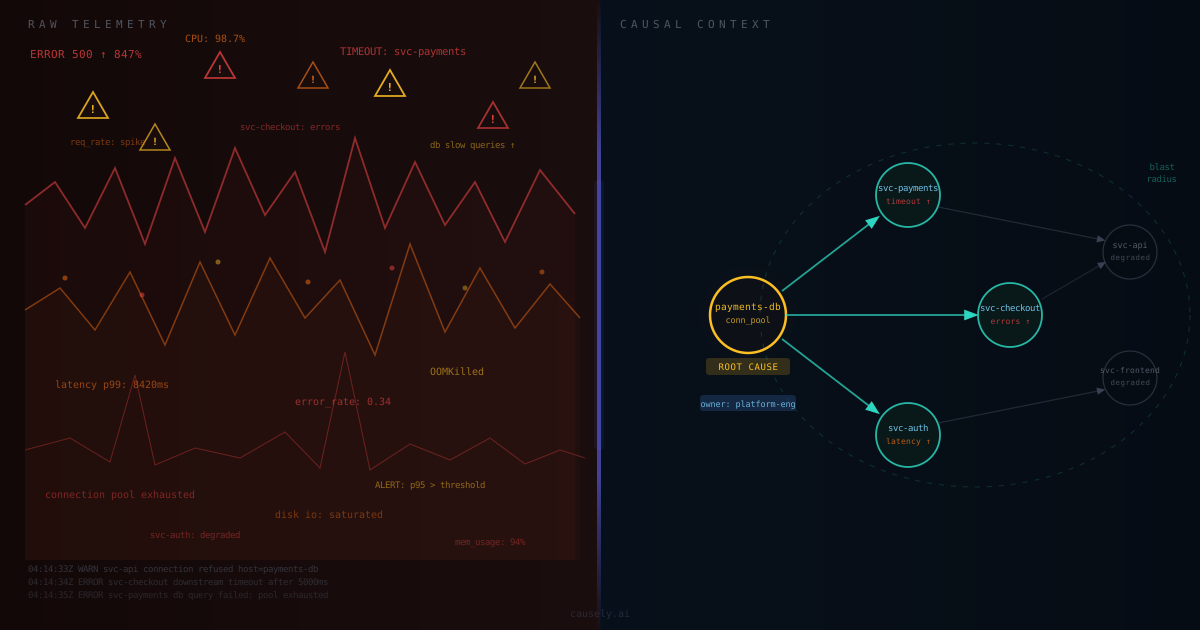
Every SRE team has heard the pitch by now: AI agents that monitor your systems, diagnose incidents, and remediate problems autonomously — no pager, no runbook, no 1 am escalation. The vision is compelling. The reality, for most organizations, is an agent that reads dashboards faster than a human and then hands the problem back to an engineer.
This isn't as much a failure of AI's promise as much as it is a failure of context.
The industry has converged on a useful framework for thinking about AI SRE maturity: a progression from Read-Only (the agent observes and explains) through Advised (it recommends) and Approved (it acts with human sign-off) to Autonomous (it executes bounded remediations without waiting for a human). The widely-held view is that enterprises rarely skip stages; the curve is governed by trust, observability quality, and risk posture.
That framing is accurate, but it undersells the most solvable part of the equation. Trust and risk posture are cultural and organizational. Observability quality is a technical problem, and it's the one most teams aren't addressing before they build their AI layer on top.
The Read-Only Trap
Most AI SRE agents today operate in Read-Only or, at best, Advised mode. Teams are using LLMs to summarize alerts, correlate metrics, and produce incident summaries that otherwise require hours of investigation. That's genuinely useful, but it's also about as far as most organizations get, and they often chalk up the stall to "we're not ready to let AI act autonomously" or "our engineers don't trust it yet."
What they rarely examine is why the recommendations aren't trustworthy. The answer is almost always the same: the agent is working from raw telemetry.
Raw telemetry — metrics, logs, traces — tells you what is happening at any given point in time across individual services. It does not tell you why. When a latency spike ripples through five services simultaneously, the telemetry shows you five sick services. It does not show you that four of them are sick because of the fifth.
Feeding that data to an LLM and asking it to recommend a remediation produces exactly what you'd expect: a confident-sounding guess. Or, worse, a sorted list of guesses to sort through. And if your AI SRE agent is guessing, the correct human response is not to approve the action. You're stuck at Read-Only, not because your team isn't ready for autonomous operations, but because your agent is not giving you any reason to trust it.
What "Observability Quality" Actually Means
When the maturity model says the progression is governed by observability quality, it points to something deeper than data completeness. Having more logs, higher-resolution metrics, or full distributed tracing doesn't necessarily close the gap. Teams at large organizations have exhaustive telemetry and still spend hours in incident bridges arguing about what caused what.
The gap is causal clarity.
There's a difference between knowing that service A is responding slowly and service B's error rate just spiked — which telemetry gives you — and knowing that service A's slowness caused service B's errors through a dependency path, and that the root cause of both is a resource contention issue three layers down in a shared infrastructure component. The first kind of knowledge lets an agent describe the incident. The second kind lets an agent act on it with defensible confidence.
Consider a failure pattern that comes up often in practice: a certificate expiration in a shared dependency triggers cascading application errors across multiple services. Traditional monitoring surfaces the application failures loudly. The expiring certificate — the actual cause — sits quietly in a dependency that nobody thought to watch. Engineers spend hours chasing error rates in services that are innocent bystanders, because the telemetry they have doesn't encode the relationship between those services and the thing that broke.
The point isn't that certificate expirations are a hard problem to fix. It's that symptom-level observability systematically leads investigators — human or AI — to the wrong place.
The Telemetry Trap
There's a reason AI agents operating on raw telemetry tend to get stuck reasoning about the most alarming service rather than the root cause. Correlation is cheap; causation is expensive. When an LLM is given a flood of metrics from a degraded system, the signals that stand out are the loudest ones, which are usually the services closest to the user experiencing the failure, not the one that initiated it.
This matters enormously when you're trying to move up the maturity curve. An agent in Advised mode recommending "restart service B" when the actual problem is a saturated database connection pool upstream isn't moving you toward autonomy; it's moving you toward an incident that gets worse after an ill-advised remediation. Engineers learn fast that approving those recommendations is risky. Trust erodes, and the agent stays in a dashboard-summarizing role indefinitely.
The problem compounds in modern microservice architectures, where a single infrastructure failure can manifest as degraded latency, increased error rates, and elevated resource consumption across dozens of services simultaneously. The blast radius is wide, the telemetry is overwhelming, and a pattern-matching approach — whether human or AI — will chase symptoms in the wrong order.
Causal Context Changes the Calculus
The alternative is to give your AI agent something it can actually act on: a structured model of how your services interact and fail, not a stream of data points to pattern-match against.
When an incident begins, an agent with access to a causal model doesn't have to correlate its way to a hypothesis. It can identify the single root cause that explains all the observed symptoms — because the model encodes the dependency structure that makes certain failure paths deterministic. It can tell you not just that service A is the root cause, but which other services are at risk of degradation (blast radius), which team owns the affected component (owner), and whether this failure path has been seen before.
That's the kind of context that changes what a human approver has to evaluate. Instead of "the AI thinks maybe service B is the problem," you get "the causal model identified a saturated connection pool in the payments-db component as the root cause; it is impacting services X and Y, and service Z is in the blast radius but operating normally; the recommended action is to increase the pool limit or, alternatively, scale the downstream consumer." An autonomous agent with appropriate guardrails can now be trusted to take action.
This is why the path from Read-Only to Autonomous isn't primarily about the sophistication of your AI model or the maturity of your team's risk posture. It's about whether the agent has access not only to information, but to knowledge that's trustworthy enough to act on.
The Practical Path Forward
None of this requires replacing your observability stack. The telemetry you're already collecting with legacy APM tools, OpenTelemetry, or Prometheus is a necessary input. It feeds the detection layer that surfaces anomalies and triggers investigation. What changes is what sits between that telemetry and your AI agent: a causal reasoning layer that transforms noisy signals into structured, explainable system knowledge.
That context is continuously maintained by the system and delivered via MCP the moment an agent needs it. No broad environment scan, no waiting for context to be accumulated, no wasted tokens. In a benchmark study we'll soon share publicly, causal context cut an agent's average token consumption by 48% and mean query time by 63%.
When AI agents receive that context — root cause, symptoms, blast radius, etc. — they can do something far more useful than summarize an alert. They can reason about the system the way a team of senior engineers and architects with deep institutional knowledge would, but at an unmatched speed and scale.
That's what moving up the maturity curve actually requires. Not more data, and not braver approval workflows. A layer between the noise and the agent that turns what's happening into why it's happening, and what to do about it. Agents that stop guessing, burn fewer tokens, and act proactively.
Most AI SRE deployments will stay stuck on Read-Only until teams address this gap. The good news is that it's addressable.
Build ops agents you can trust at scale.
Causely's MCP server gives your agents deterministic causal context so they stop guessing, burn fewer tokens, and act proactively.