Why A2A Joining the AAIF Matters

Yotam Yemini
August 17, 2026
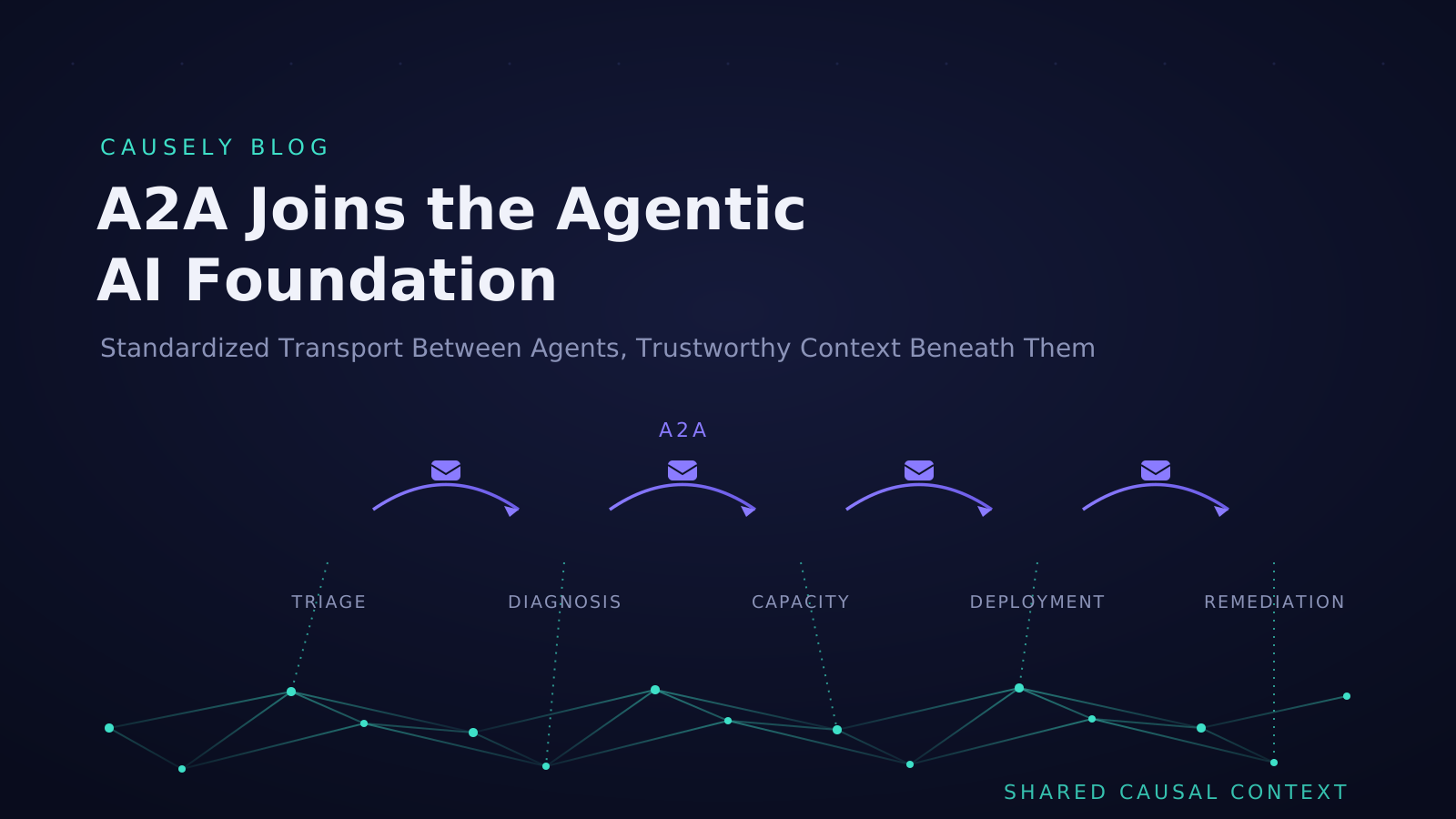
Today the Agentic AI Foundation announced that the Agent2Agent (A2A) protocol has been accepted as a growth-stage project. A2A started at Google, moved to the Linux Foundation in 2025, and now sits alongside MCP, goose, and AGENTS.md under the AAIF's neutral governance.
Causely is a member of the AAIF, and we want to share why we think this news matters for anyone building agents for autonomous service reliability.
The Protocol Layer Is Maturing
If you think back to the early internet, almost nothing interesting got built until TCP/IP, DNS, and HTTP existed as neutral protocols. The same evolution is happening in the agent ecosystem, just compressed into a much shorter period.
MCP quickly became the standard for how agents connect to tools and context. In parallel, A2A became the standard for how agents talk to each other about capability negotiation, task handoff, and replanning across agent boundaries. But while MCP became an AAIF project as part of the foundation being formed in December 2025, A2A stayed at the Linux Foundation level.
With this announcement today, the two core protocols of the agent stack share one governance home and community. Shared neutral governance is what turns a promising spec into infrastructure people build on for a decade or more.
Why This Matters for Autonomous Service Reliability
Most teams we talk to are building their own agents today, and A2A makes it more practical to wire multi-agent systems together. With a standard protocol for capability negotiation, task handoff, and replanning, teams can compose systems from agents built by other teams, other vendors, or open source projects. We expect multi-agent architectures to become more common, and to increasingly include agents whose internals you never see.
Each handoff is a message crossing an agent boundary, which is also where the risk compounds. If one agent is guessing, its errors stay local. But if that agent hands its conclusions to another agent over A2A, the guess travels. Like a childhood game of telephone, one agent’s guess gets treated as another agent’s fact. Audit trails help you reconstruct what went wrong, but only after the fact. At machine speed, the only real-time lever you have is grounding each agent with the right context at the right moment.
This is a core problem Causely exists to solve. Our causal reasoning system gives your agents deterministic context about cause-and-effect across the entities that make up your cloud-native or GenAI application. When something degrades in a part of your stack, your agents don’t need to waste time building context from raw telemetry.
With Causely, agents get the prioritized root cause, together with the diagnostic evidence that matters. Causely is also continuously monitoring SLOs and symptom activation to automatically detect emerging problems. That means it can trigger a background agent proactively with the specific issue and related context, rather than waiting for a human or scheduled run to initiate.
If you are building SRE and ops agents or trying to achieve autonomous service reliability, you need both standardized transport between agents (A2A under the AAIF) and trustworthy context that grounds them (Causely).
Why Causely Joined the AAIF
We joined AAIF because our customers are building here. Causely ships as a containerized system with an MCP server. The teams we work with are wiring agents into their observability stack and related internal tooling, and they're starting to connect agents to each other. The standards governing that plumbing will shape what's possible in AI-driven operations for years to come.
We're looking forward to helping shape those standards, especially interoperability ones that matter for operational context: how agents share context, how they keep each other grounded, and how they create feedback loops to check their work.
What Comes Next
Protocols are necessary but not sufficient. The next phase of this ecosystem is about the substance flowing over these wires. For our customers this means causal context that is deterministic and evidence-backed, so that ops agents they build can be trusted to act autonomously and at machine speed.
Congratulations to the A2A maintainers and the AAIF governing board on today’s news. If you're building SRE or ops agents on MCP or A2A and thinking about the inherent trust and speed problems, we'd love to compare notes.