A Cursor Plugin for AI Ops Agents You Can Trust in Production

Yotam Yemini
May 12, 2026
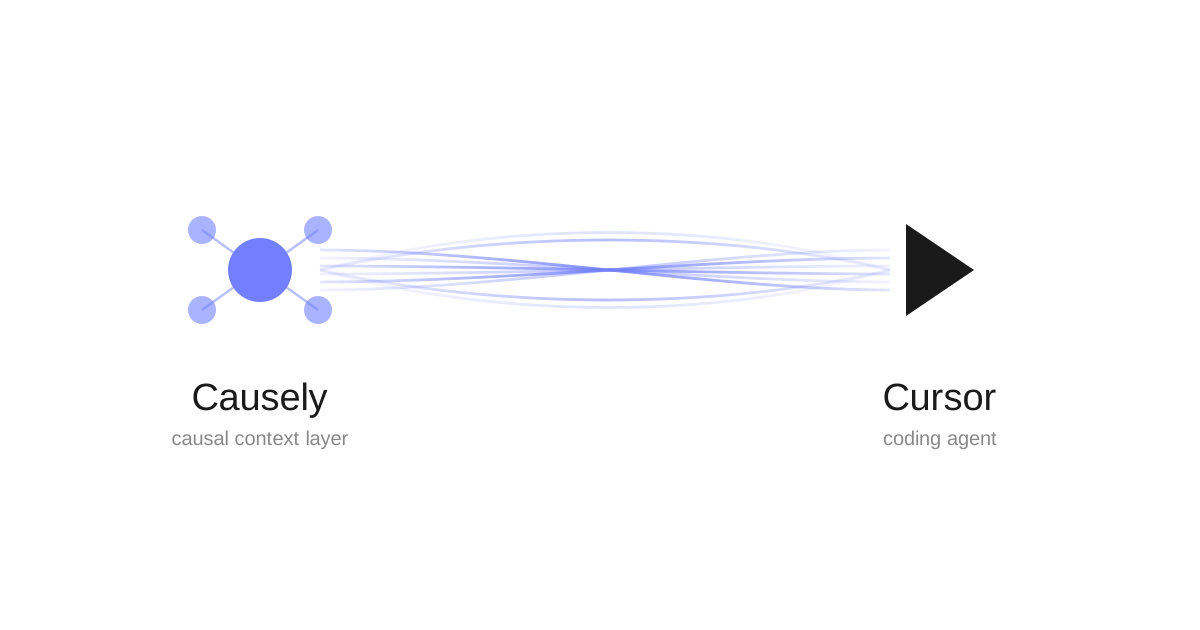
Causely is now available as a plugin in the Cursor directory.
Most AI ops agents fail for the same structural reason. They have no semantic layer over the environment, so when an incident hits, the only way to reason about it is to pull mountains of data and ask an LLM to figure out what matters.
That approach scales inefficiently and delivers inconsistent results. The more telemetry you have, the more data the agent must pull before it can answer anything. The answers are only as good as the model’s ability to find the proverbial needle in the haystack. This increases latency and token consumption without necessarily increasing accuracy.
Causely is built on the opposite principle. The system’s causal context layer encodes how your services depend on each other and how failures propagate, so an agent can ask what caused this? and get a deterministic answer without an ad-hoc scan of the whole environment.
Tools for the agents you’re already building
There’s a category of vendor right now selling a packaged AI SRE. These are mostly LLM wrappers sitting on top of your environment, claiming to run investigations as a human would, and offering to hand you plausible answers as output. In many cases, these tools require access to your source code.
We don’t think that’s the right solution shape. The teams who run production systems at scale are already building their own agents. What those teams need is not yet another agent. They need infrastructure that optimizes the performance and efficiency of the agents they’re building.
That’s where Causely fits. The Causely MCP server gives any human or agent a continuously maintained ontology and deterministic causal context about the behavior of their environment. Causely gives engineering teams the substrate that makes their agentic ops workflows reliable You can read more about our MCP server here: https://docs.causely.ai/agent-integration/mcp-server/.
How Cursor and Causely Work Together
Causely continuously scans your environment for emerging causes of congestion and malfunction, including when you haven't explicitly configured a monitor or alert. These are reliability risks that can be addressed proactively, before an incident occurs or is declared.
In a pre-AI world, proactive maintenance work mostly sat in a backlog because it felt like there were never enough engineering hands to work through it. With Cursor and other coding agents, that constraint is loosened.
Causely runs in your cluster and processes your telemetry locally. Cursor as your coding agent already has access to your codebase and git history. So rather than building our own code-aware remediation surface, we made Causely available directly inside Cursor. When Causely pinpoints a code-related cause of observed congestion or malfunction in your operating environment, Cursor can take that context and propose the fix in the code that produced it.
You can install it here: https://cursor.directory/plugins/causely.
Get started
Search for Causely in the Cursor plugins directory or use the link provided above, install it, and point it at your Causely instance. Your agent gets deterministic causal context with no extra data access required.
If you're building ops agents and want to see how the causal context layer fits into what you're working on, you can try Causely here: https://www.causely.ai/try.